




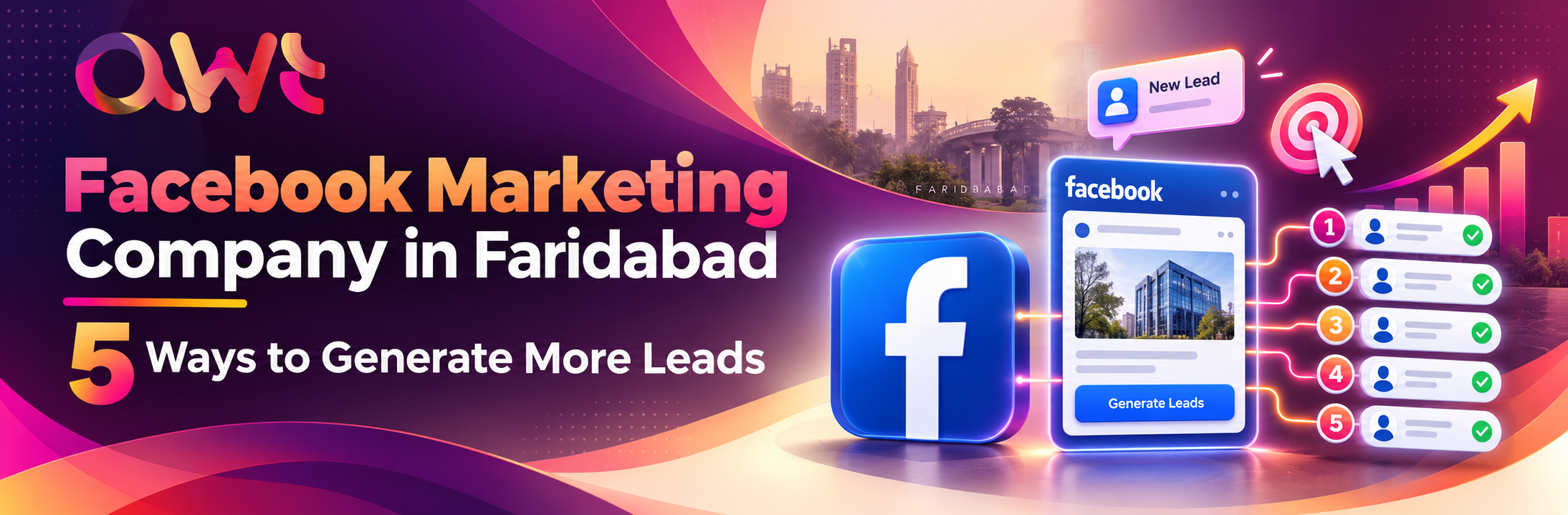
A boutique owner once told me she'd spent three months "boosting posts" on Facebook and couldn't point to a single sale that came from any of it. She wasn't wrong to be frustrated, either. Boosting a post with a nice photo isn't really Facebook marketing, not in any way that actually generates leads. It's closer to putting up a poster somewhere and just hoping the right person happens to walk past it.
Real Facebook marketing, the kind that actually brings in enquiries, looks nothing like that at all. It's built around specific audiences, tested creative, and a landing experience that matches what the ad actually promised. Most businesses in Faridabad who feel like "Facebook doesn't work for us" honestly haven't tried that version yet — what they've tried is a social media marketing company running the same recycled boosting strategy on every client regardless of what the business actually sells.
Quick answer: a Facebook marketing company in Faridabad generates leads by combining precise audience targeting, ad creative built around a clear offer, and landing pages designed to convert — not by simply boosting posts or running generic brand-awareness campaigns. Any decent Meta Ads agency Faridabad businesses actually see results from will tell you this upfront, before ever quoting a monthly budget. This works well for businesses with a visual product or service and a defined local audience. It works less well for businesses with long, complex B2B sales cycles, where other channels often carry more weight.
Why Facebook Still Matters for Local Lead Generation
People assume Facebook's relevance has faded, mostly because of how much attention Instagram gets in conversation these days. Fair enough, honestly — Instagram's where a lot of the visual energy has gone. But in practice, Meta's ad platform, which runs both Facebook and Instagram together under one system, still has some of the most detailed audience targeting available anywhere, especially for local, interest-based, and demographic targeting that suits small and mid-sized businesses well. Any Instagram marketing agency worth its fee is really just running the same Meta Ads infrastructure underneath, whatever platform gets emphasized in the pitch.
There's a local clinic that had struggled for years to generate enquiries through its website, and this is exactly what they discovered once they actually tried it properly. Their organic reach on Facebook was minimal, understandably so, since organic reach for business pages has shrunk considerably over the past several years. But a small, well-targeted lead generation campaign aimed specifically at people within a defined radius who matched relevant demographics brought in enquiries within the first two weeks, at a fraction of what a broader campaign would've cost them.
Five Ways This Actually Generates Leads, Not Just Engagement
Targeting people who are actually likely to buy, not just anyone nearby. Meta's targeting options go well beyond location and age, genuinely. Interest-based targeting, lookalike audiences built from your existing customers, and retargeting people who've already visited your website all narrow the audience toward people who are actually more likely to convert, not just more likely to click.
Building and creative around one clear offer, not some vague brand message. Ads that say "check out our services" underperform compared to ads offering something specific — a free consultation, a limited discount, a clear next step to take. Specificity gives someone a reason to click right now instead of just scrolling past without a second thought.
Sending traffic to a dedicated landing page, not a generic homepage. This is where a lot of otherwise decent campaigns quietly fall apart. If the ad promises a specific offer and the landing page doesn't mention it anywhere, visitors bounce almost immediately, and the ad spend gets wasted on traffic that never really had a chance to convert in the first place.
Testing multiple ad variations before scaling spend. Running one ad and hoping it performs is a gamble, plain and simple. Testing two or three variations of an image, headline, or offer against a small budget first, then scaling whatever actually performs, saves money and improves results considerably over time. Genuine Facebook lead generation services build this testing phase in from the start rather than skipping straight to scaling.
Retargeting people who showed interest but didn't convert the first time around. Most people don't buy or enquire on their first interaction with an ad, which surprises fewer business owners than you'd think once you point it out. A retargeting sequence aimed at people who visited the landing page or engaged with the ad but didn't convert catches leads that a single-touch campaign would simply lose for good.
Where Businesses Get This Wrong
Treating boosted posts as a real ad strategy is probably the most common one. Boosting reaches more people, technically, sure, but it doesn't offer the targeting precision, tracking, or optimization that a properly built campaign through Meta Ads Manager does. It's really the difference between throwing a wider net out and actually aiming at something specific.
Running ads without a clear landing page trips up a lot of otherwise solid campaigns. There's a manufacturing company I know that once ran a well-targeted Facebook campaign pointing straight to their homepage instead of a dedicated page addressing the specific offer in the ad. Click-through rates looked fine on paper. Conversions didn't, because visitors landed somewhere that didn't match what they'd actually clicked for.
Judging performance by likes and comments instead of actual leads is another classic. Engagement metrics feel good to look at, admittedly, but they don't pay bills. A campaign with modest engagement and steady enquiries is doing its job far better than one with viral reach and nothing to show for it once you check the numbers that matter.
Ignoring mobile experience on the landing page happens more than you'd expect, even from a supposedly experienced Facebook ads management company. Most Facebook traffic arrives on a phone, and a landing page that loads slowly or displays awkwardly on mobile kills conversions before someone's even finished reading the offer.
Setting a campaign live and never touching it again rounds out the list. Facebook's algorithm needs time to optimize, sure, but it also needs actual monitoring. A campaign left completely unattended for weeks can drift toward an audience that's technically cheap to reach but genuinely unlikely to ever convert.
What This Looked Like for a Few Real Businesses
There's an ecommerce store I worked with that had solid organic SEO already but wanted faster, more immediate sales during a seasonal push. A short Facebook campaign built around a specific limited-time offer, pointed at a landing page matching that exact offer, brought in a meaningful lift in conversions during that window — something SEO alone genuinely couldn't have delivered fast enough for a seasonal deadline like that.
A startup I know had been running Facebook ads for months with a decent budget behind them but pretty disappointing results. The problem, once we actually dug in, wasn't the targeting or the creative at all. It was that every single ad pointed to their generic homepage instead of a page built around what the ad actually offered. Once a proper landing page got built and connected to the existing campaigns, their cost per lead dropped meaningfully, without any increase in spend whatsoever.
A local service business generating steady calls after investing in Local SEO added a modest Facebook lead generation campaign on top of that, aimed at people in their specific service area who hadn't yet heard of them through search. The two channels ended up complementing each other rather than competing, since Facebook reached people who weren't actively searching yet but became genuinely warm leads once retargeted a few times over.
Boosting a Post vs. Running a Proper Campaign
This is really the core distinction that decides whether paid social media advertising actually works for a business or just burns through a budget quietly. Here's how the two compare:
|
Factor |
Boosted Post |
Managed Ad Campaign |
|
Targeting precision |
Basic, limited options |
Detailed, including lookalike and retargeting audiences |
|
Tracking |
Minimal, mostly engagement metrics |
Full conversion tracking through Meta Pixel and Analytics |
|
Landing experience |
Usually points to the post or profile |
Built around a dedicated, offer-specific landing page |
|
Optimization |
Little to none |
Ongoing testing and budget adjustment based on real data |
|
Best suited for |
Quick visibility, low stakes |
Actual lead generation and measurable ROI |
If lead generation is genuinely the goal, a managed campaign through Meta Ads Manager, built with proper tracking and a real landing page, consistently outperforms boosting, even at similar budgets, whatever a boosted post's cheaper price tag might suggest at first glance.
Expert Tips Worth Knowing
Install the Meta Pixel on your website before launching any campaign, not after the fact. Without it, you're basically optimizing blind, and comparing results across campaigns becomes guesswork rather than anything resembling real analysis.
Start with a modest budget to test creative and audiences before committing serious spend to anything. What performs well in testing rarely stays exactly the same at scale, but early data still tells you a lot about which direction to actually go in.
Match your landing page headline directly to your ad's promise, word for word if you can manage it. This single alignment fixes more underperforming campaigns than any amount of creative polish ever really does.
Don't ignore comments on your ads, tempting as it might be to leave them alone. Genuine questions in the comments section are often warm leads asking to be engaged with directly, and responding promptly can convert them without spending an extra rupee.
Review campaign performance weekly, at minimum, not just when something feels off. Facebook's algorithm shifts, audiences fatigue over time, and a campaign that performed well a month ago may need fresh creative just to keep converting at the same rate it used to.
Checklist Before Running a Facebook Lead Generation Campaign
It's worth being honest with yourself about a few things first. Is there a specific, clear offer actually driving the campaign, rather than some vague brand awareness goal nobody can measure? Is the landing page built specifically around that offer, and has it been tested on mobile before launch? Is the Meta Pixel installed and tracking conversions properly, not just clicks that don't mean much on their own? Is there a retargeting sequence planned for people who don't convert immediately the first time? And is someone actually reviewing performance regularly, rather than setting the campaign live and quietly forgetting about it for a month?
Conclusion
Facebook Marketing Company in Faridabad generates real leads when it's treated as a proper campaign, not a series of boosted posts hoping for the best somehow. Precise targeting, a clear offer, and a landing page built to match all matter more than budget size alone, whatever a bigger monthly spend might seem to promise.
CTA
Ara Web Technologies runs Facebook and Meta Ads campaigns alongside landing page design, SEO, and broader digital marketing work, since a well-targeted ad pointed at a weak landing page rarely delivers the results a business actually needs. As a digital marketing agency for small business clients specifically, we'd rather fix the landing page first than sell more ad spend on top of a broken funnel. If you're considering Facebook marketing for your business, getting the landing experience right first is usually the most valuable place to start.
FAQs
How much does Facebook marketing typically cost in Faridabad?
Costs vary quite a bit by industry competitiveness and campaign goals. Management fees are separate from ad spend itself. Get a clear breakdown of both before comparing quotes across different providers.
How is Facebook marketing different from just boosting a post?
Boosting offers basic reach with minimal targeting or tracking behind it. A managed campaign uses detailed audience targeting, conversion tracking, and dedicated landing pages, producing measurably better lead generation results for the same or similar spend.
How soon will Facebook ads actually generate leads?
Campaigns can go live within days, though meaningful optimization takes a couple of weeks as the algorithm gathers enough data to work with. Expect an initial testing period before judging performance or scaling budget with any real confidence.
Do I need a website to run Facebook lead ads?
Not strictly, since Facebook offers native lead forms built right into the platform. That said, a dedicated landing page usually improves lead quality and conversion rates compared to relying on Facebook's built-in forms alone.
Is Facebook marketing better than Google Ads for lead generation?
Neither is universally better, honestly. Facebook suits visual products and interest-based targeting well. Google Ads captures active search intent instead. A lot of businesses genuinely benefit from using both, depending on budget and goals.
Leave a comment
If you have any questions or would like to book a session please contact us.