



A restaurant owner in Delhi once showed me his Instagram analytics with real pride — decent reach, steady likes, a following that had grown month over month for over a year. Then I asked how many actual table bookings had come from any of it. He genuinely didn't know. Nobody had ever set up a way to track that connection, so the numbers on the screen and the money in the till had never really been linked together.
That gap is the whole story behind most conversations about social media marketing services in Delhi. Posting consistently builds a presence. It doesn't automatically build a pipeline of paying customers, and treating those two things as the same goal is where a lot of businesses lose months chasing the wrong metric.
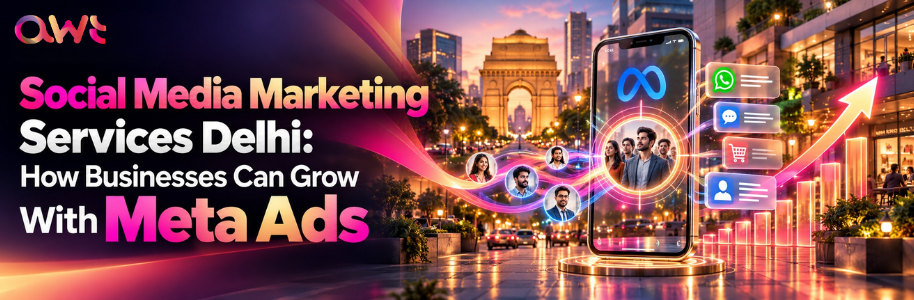
Quick answer: social media marketing services in Delhi that actually generate business results combine organic content for trust and visibility with Meta Ads for direct, trackable lead generation — built around a specific offer, precise targeting, and a landing page that matches what the ad promises. Proper Meta Ads management Delhi businesses can actually rely on treats this as a system, not a one-off boost. Businesses relying purely on organic posting typically plateau once their existing audience stops growing, since Meta's algorithm limits organic reach for business pages by design. This is really the core distinction that separates real social media advertising services from someone simply scheduling posts on your behalf.
Why Organic Content Alone Usually Isn't Enough
Organic reach for business pages on Facebook and Instagram has shrunk considerably over the years, and this isn't accidental. Meta's ad revenue depends on businesses paying to reach people, so free organic distribution gets deprioritized in the algorithm. A page posting good content consistently might still only reach a small slice of its own followers on any given day, let alone new people who've never heard of the business.
This is exactly why Meta Ads exist as a separate, deliberate tool rather than just a faster version of posting. Instead of hoping the algorithm decides to show your content to the right people, you're paying to guarantee specific targeting — by location, interests, past website visits, or similarity to existing customers. Any competent Facebook and Instagram ads agency will tell you this upfront: the two platforms run on the same ad infrastructure, so a campaign built well for one usually extends naturally to the other.
Benefits That Actually Show Up in Real Campaigns
Precise local targeting that organic reach can't match. A campaign can target people within a specific radius of Faridabad or a particular Delhi neighborhood, matched to relevant interests and demographics, rather than hoping the right local audience happens to see an organic post. This kind of hyper-local precision is one of the main reasons paid social campaigns NCR-wide tend to outperform generic national ones for small and mid-sized businesses.
Retargeting people who've already shown interest. Someone who visited your website or engaged with a previous ad but didn't convert can be shown a follow-up ad specifically, catching leads a single-touch approach would otherwise lose entirely.
Measurable cost per lead instead of vague brand awareness. With proper tracking through the Meta Pixel, a business can see exactly what it costs to generate an inquiry, rather than guessing whether social media spend is actually working.
Faster testing of what resonates. Running a few ad variations against a small budget reveals what messaging, image, or offer performs best, long before committing serious spend to a single approach that might not land at all.
Direct connection between ad spend and website performance. Ads pointed at a well-built landing page create a measurable funnel from click to conversion, something organic posts pointed at a bio link rarely provide with the same clarity.
Common Mistakes Businesses Make With This
Treating a boosted post as equivalent to a properly managed campaign. Boosting reaches more people, technically, but skips the detailed targeting, retargeting options, and conversion tracking a real campaign through Meta Ads Manager actually uses.
Running ads without a dedicated landing page. A startup I worked with had been running Meta Ads for months with decent spend but underwhelming results, and the actual problem wasn't the targeting or creativity at all. Every ad pointed to their generic homepage instead of a page built around the specific offer. Once a proper landing page went live, matched exactly to what the ad promised, their cost per lead dropped meaningfully without any change in spend.
Judging success by likes and comments rather than actual enquiries. Engagement feels good to look at, understandably, but it doesn't pay rent. A campaign with modest engagement and steady real leads is doing far more for a business than one with high engagement and nothing measurable to show for it.
Expecting results within the first few days. Meta's algorithm needs time and real data to optimize toward the right audience. Judging a campaign as a failure after three or four days, before it's had a chance to actually learn, usually leads to premature and inaccurate conclusions.
Ignoring how a weak website undermines good ad targeting entirely. I worked with a manufacturing company that had lost real organic traffic after a poorly handled website redesign, and no amount of well-targeted social ad spend could compensate for a site that took nearly eight seconds to load on mobile. Visitors arrived through the ads just fine. Most left before the page even finished loading.
What This Looked Like Across a Few Real Businesses
A local clinic that had struggled for a long time to generate real enquiries had a Facebook page filled with pleasant, well-meaning content — health tips, doctor introductions, general awareness posts. None of it asked visitors for anything specific. This is a common gap in Instagram marketing for business generally, not just Facebook — plenty of visually appealing content with no actual call to action anywhere. Once a small, targeted campaign ran alongside that content, offering a clear next step like booking a consultation, enquiries started coming in within the first couple of weeks. The organic content hadn't changed at all. What changed was giving people something concrete to actually respond to.
An ecommerce store running Meta Ads alongside its existing SEO work found the two channels reinforced each other rather than competing for attention. Ads brought fast, immediate traffic during a seasonal push, while SEO kept building a base of organic visitors that required no ongoing spend at all. Neither replaced the other. They filled genuinely different gaps in the same overall strategy.
A local service business generating more calls after investing in Local SEO added a modest Meta Ads campaign on top, aimed specifically at people in their service area who hadn't yet found them through search. The two channels complemented each other well, since ads reached people who weren't actively searching yet but became warm leads once retargeted a couple of times.
Organic Social Media vs. Meta Ads: An Honest Comparison
|
Factor |
Organic Content |
Meta Ads |
|
Reach |
Limited, shrinking over time |
Precisely targeted, scalable with budget |
|
Cost |
Time investment, no direct spend |
Ongoing ad spend required |
|
Tracking |
Difficult to connect to real leads |
Measurable through Meta Pixel and Analytics |
|
Speed |
Slow, builds gradually |
Fast, live within days |
|
Best suited for |
Building trust and brand familiarity over time |
Direct lead generation and measurable conversions |
Most businesses genuinely need both, not one instead of the other. Organic content builds the trust that makes an ad feel credible when someone sees it; ads generate the leads organic content alone usually can't deliver on any predictable schedule.
Expert Tips Before You Commit Budget
Install the Meta Pixel before launching anything, not after. Without it, every optimization decision afterward is based on guesswork rather than real data.
Start with a modest testing budget across two or three ad variations before scaling spend on a single approach. What performs in testing rarely stays identical at scale, but it still tells you which direction to move in.
Match your landing page headline directly to your ad's offer. This single fix resolves more underperforming campaigns than any amount of creative polish applied afterward.
Don't ignore comments on your ads. Genuine questions there are often warm leads asking to be engaged with directly, and responding promptly can convert them without spending anything extra.
Review performance weekly at minimum. Audiences fatigue over time, and a campaign performing well this month may need fresh creative next month to keep converting at the same rate.
Checklist Before Running a Social Media Campaign
Is there a specific offer driving the campaign, rather than a vague brand awareness goal nobody can actually measure? Is the landing page built specifically around that offer and tested properly on mobile? Is the Meta Pixel installed and tracking real conversions, not just clicks? Is a retargeting sequence planned for people who don't convert on the first interaction? And is someone actually reviewing performance regularly, rather than launching the campaign and leaving it alone for weeks?
Conclusion
Growing a business through social media comes down to connecting two things that often get treated separately: organic presence that builds trust, and paid campaigns that generate trackable, measurable leads. Neither one alone tends to do the whole job well.
CTA
Ara Web Technologies runs Meta Ads alongside SEO, landing page design, and web development, since a well-targeted ad pointed at a weak website rarely delivers what a business actually needs. As a digital marketing agency Delhi and Faridabad businesses can both work with directly, we'd rather flag a weak landing page upfront than sell more ad spend on top of it. If you're considering social media marketing services for your business, checking whether your website can actually support that traffic is a reasonable place to start before committing to an ad budget.
FAQs
How much do social media marketing services cost in Delhi?
Costs vary by scope and ad spend involved. Management fees are typically separate from the actual ad budget. Get a clear breakdown of both before comparing quotes across different providers.
Is Meta Ads better than boosting a post?
Yes, for actual lead generation. Boosting offers basic reach with minimal targeting or tracking. Managed campaigns through Meta Ads Manager use detailed targeting and conversion tracking, producing measurably better results.
How soon do Meta Ads show results?
Campaigns can go live within days, though meaningful optimization takes one to two weeks as the algorithm gathers data. Judge performance after that initial learning period rather than immediately.
Do I need a website to run effective social media ads?
Not strictly, since Meta offers native lead forms. A dedicated landing page usually improves lead quality and conversion rates compared to relying on Meta's built-in forms alone, though.
Can social media marketing work for B2B businesses too?
Yes, though results tend to be slower and more indirect than for retail or local service businesses. Brand familiarity and retargeting still help support a longer B2B decision-making process over time.